
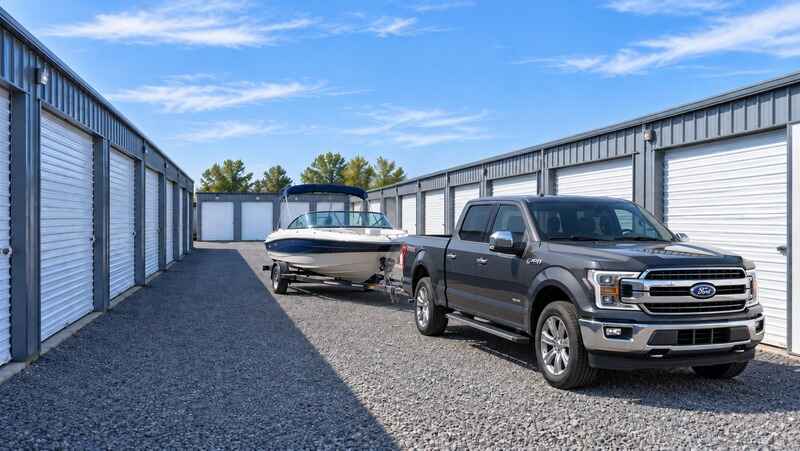
Are you looking for boat storage near Flathead Lake? Good news. Secure boat storage exists in the Flathead Valley. The best boat storage options sit along the Highway 93 corridor between Kalispell and Whitefish. Because of that location, you can reach Flathead Lake, Foys Lake, Lake Blaine, and the rivers without a detour. For example, Stillwater Storage in Kalispell offers drive-up boat storage bays sized for trailered boats. You also get climate-controlled units for gear, gated access, and month-to-month terms. As a result, you never sign a long lease for a seasonal hobby.
That is the quick version. First, this boat storage guide explains why storage matters here. Next, it describes the local water. Then it lists what to check before you rent boat storage. Finally, it shows when to move your boat in and out. Use the table of contents to jump to any section.
Boat ownership in northwest Montana has a built-in contradiction. People buy boats here for Flathead Lake, the rivers, and the small lakes around Kalispell. However, those same boats need boat storage safer than a driveway when they sit idle. The boating season is short and intense. A few warm months sit between long, harsh winters. In fact, every boat spends more time parked than on the water.
First-time owners often miss this math until fall. Then the question arrives: where does the boat go? Most owners keep it at home. They park it in the driveway or under a tarp. It costs nothing, so it seems fine for a year or two. But trouble starts soon enough. Snow cracks a hull. A trailer blocking the sidewalk draws a citation. Or the boat simply looks worse after one winter outside.
Boat storage near Flathead Lake fixes the practical problem. It also brings peace of mind. Your boat stays behind a gate, under a roof, and out of the weather. That is one less worry from October to May. Since those months make up more than half the year here, good boat storage pays off.
Boat storage near Flathead Lake serves more than one lake. Kalispell boaters rotate between several bodies of water. Each has its own character. Therefore, a boat storage facility works best when it sits close to all of them.
Flathead Lake anchors the region. It is the largest natural freshwater lake west of the Mississippi River. It runs about 28 miles long and 15 miles wide. Glaciers carved it, and public access points ring the shore. Several units of Flathead Lake State Park have boat launches. Wild Horse Island sits inside the lake. You can only reach this state park by water. Bighorn sheep and wild horses still roam its ponderosa pines. The lake also holds the state record for lake trout. Someone caught a 42.69-pound fish in 2004. As a result, serious anglers treat the lake as a destination.
Most Kalispell boaters use access points on the north end, near Somers and Lakeside. Both sit a short drive down Highway 93. Good boat storage keeps that route simple. A boat storage facility on the Highway 93 corridor needs no detour through town. Instead, you skip extra miles when you pick up the boat and again when you head home.
Foys Lake is small and close. It suits a quick evening on the water. It sits a few miles southwest of downtown Kalispell, near Lone Pine State Park. Its 235 acres show a turquoise color because sunlight bounces off the sandy lakebed. Flathead County runs a public boat launch, docks, and a roped swimming area at Foys Lake Park. On summer afternoons, water skiers and tubers often outnumber anglers.
Proximity makes Foys Lake matter for boat storage. Do you want to launch an hour after work? If so, pick boat storage that sits about as close to Foys Lake as to the big lake.
Lake Blaine lies east of Kalispell in the Stillwater Valley. It draws a quieter crowd. Trout anglers and families with small boats favor it. Locals know it as a low-key fishing lake, not a watersports hub. Also, it has its own public boat launch. Boaters who split time between Flathead Lake and Lake Blaine need flexible boat storage. Fortunately, a boat storage facility on Highway 93 sits roughly between the two.
Two more lakes reward boaters who travel a bit further. Ashley Lake sits west of Kalispell in the Salish Mountains. It offers quiet water and good fishing. Echo Lake lies about 20 miles southeast, near Bigfork. Its water runs warmer than most local lakes because more of it comes from groundwater than from mountain runoff. Swimmers and personal watercraft fans love it in midsummer.
Neither lake sees as much traffic as Flathead Lake. Still, both come up when locals plan a weekend. They prove a point. Flathead Valley boaters rarely stick to one lake. For that reason, a central location matters more for boat storage here than in a one-lake town.
Not every boat is a wakeboard boat or a pontoon. Kayakers, canoeists, and drift-boat anglers use the rivers too. The Stillwater River and the Whitefish River both run through the valley. They meet just outside town and flow into the Flathead River. The Whitefish River starts at Whitefish Lake. It runs about 25 miles south. Canoes and inflatable kayaks float it easily. Meanwhile, the Stillwater River runs through Kalispell. Leisure Island Park gives non-motorized craft a ramp. Lawrence Park offers an easy put-in.
Small craft need different boat storage than a 24-foot pontoon. Canoes, drift boats, kayaks, and jon boats often fit best in smaller climate-controlled boat storage units. Those units protect the craft. Moreover, they keep paddles and life jackets dry.
Leaving the boat at home tends to fail in the Flathead Valley. The reasons go beyond looks. Simply put, home is not real boat storage.
Kalispell sits in USDA hardiness zone 5a. Winter lows reach about -15°F. Colder years drop near -20°F. The first frost lands around mid-September. After that, snow threatens anything left uncovered. A cubic foot of fresh, dry snow weighs about 7 pounds. However, compacted snow can weigh 20 pounds or more. Chinook thaws and refreezes add even more weight. Over a Montana winter, that load bends frames and tears seams. Then water pools, and mold and rot follow.
This is not a hypothetical. Canvas covers and blue tarps fail every winter across the valley. They shed light rain. Yet they cannot carry structural weight for months. Proper boat storage removes that risk.
The law adds another risk. Kalispell's municipal code bans vehicles and trailers that block driveways, alleys, and sidewalks. Ordinance No. 1829 updated those parking rules. Civil fines can reach a few hundred dollars. Repeat offenders pay more. A trailer at the curb risks a citation, and so does a trailer that creeps onto the sidewalk. In addition, many newer subdivisions have homeowners' associations. They often ban boat parking in front yards or driveways. Many owners learn the hard way that home boat storage is not simple.
A boat that sits outside collects damage quietly. Rodents love a quiet backyard in winter. They chew upholstery and wiring. You may not notice until spring. Summer sun does its own harm. For example, UV rays fade gelcoat and crack vinyl. Interiors bake at temperatures higher than most owners expect. None of it happens overnight, which is why owners underestimate it. Eventually, a boat with ten good years left starts needing repairs early. Good boat storage prevents that.
Once you decide to move your boat from home, ask what to look for. Not all boat storage is equal. The right choice depends on your boat, your budget, and your season.
Facilities sell boat storage bays by length and width. They do not sell by boat type. So match your boat and trailer length to the right bay. That avoids wasted space. It also avoids a boat that will not fit. A ski boat, bass boat, or small fishing boat on a trailer usually fits a 14-foot by 40-foot bay. Large pontoons, houseboats, and long combinations need about 15 feet by 50 feet. If you are not sure how your rig measures up, ask the boat storage facility. A bay that runs a few feet short ruins move-in day.
Not every boat needs the same protection. Paying for too much boat storage is a common mistake. A standard enclosed, drive-up bay solves the big problems. It blocks snow load, wind, sun, and casual break-ins. That protects the hull and structure of most boats. Climate-controlled boat storage adds a steady temperature range. Consequently, it protects electronics, fish finders, upholstery, and cushions from hard freezes. Many owners use both. The boat sits in a standard bay, while the gear sits in a small climate-controlled unit nearby.
A stored boat sits untouched for weeks. Because of that, security matters more than it does for daily-use items. Gated access limits who can enter the property. Continuous video surveillance matters when you rarely check in. Keyless entry, such as a keypad or app, removes the lost-key risk. No feature guarantees safety alone. Together, however, they show a facility built for long-term boat storage. They show it is not just household self-storage.
Security matters while the boat sits. Access matters when it moves. Drive-up bays let you hitch up and pull out. You avoid narrow hallways, and you skip the front desk. Extended or 24-hour access helps early risers headed to Flathead Lake at sunrise. It helps late arrivals back from Foys Lake too. Online rental and bill pay also save effort. After all, most owners want to think about boat storage only a couple of times a year.
Price depends on size, cover, and climate control. Expect standard drive-up boat storage bays to start in the mid-$300s per month for smaller sizes. Larger 15-by-50 bays cost more. Climate-controlled units cost extra and scale with square footage. Prices shift with season and availability. Boat storage units fill fastest before the first hard frost. So get a firm quote from the facility. Reserve early if you need a specific size.
Boat storage works best as a yearly rhythm. Good timing makes boat storage easier.
The best window runs from Labor Day to mid-September. Lake crowds thin out. Meanwhile, the weather still lets you drain systems and clean the hull. Boat storage facilities also have more openings before the rush. If you wait for snow, every step gets harder. You still drain water systems, stabilize fuel, and disconnect batteries. But now you do it in the cold. Besides that, the boat sits exposed longer.
Move a winterized boat into covered or climate-controlled boat storage. Then winter becomes the easy part. No more snow checks on a tarp. You can forget about frozen water lines. Rodent inspections also end. Your boat storage unit protects the boat through the coldest months. Your only task is to plan your spring prep.
When ice clears off Flathead Lake and the smaller lakes, boats from good boat storage hit the water first. De-winterizing is simple. First, walk around the boat and look for wear. Next, check battery terminals for corrosion. Then test electronics and pumps. Finally, inspect fluids and mechanical systems. Give the trailer the same care. Check tires, lights, wheel bearings, and couplers because they sit idle all winter. Do this before the first trip, whether short or long. Our spring boat prep and de-winterization checklist walks through every step.
Stillwater Storage provides boat storage at 135 Barkley Ridge Trail. It lies on the Highway 93 corridor between Kalispell and Whitefish. That puts this boat storage facility near nearly every launch point in this guide. Foys Lake sits a few minutes southwest of downtown. Likewise, the Somers and Lakeside access points sit on the north shore of Flathead Lake. Boats move into 14-foot by 40-foot or 15-foot by 50-foot bays. The bays suit trailered boats, and drive-up access keeps loading simple. Gated entry, continuous video surveillance, and keyless entry cover security. In addition, smaller climate-controlled units hold electronics and gear.
Is your boat still in the driveway as the season ends? Change that now. Choose boat storage over a tarp. Reserve a boat or RV storage unit at Stillwater Storage. Give your boat a real off-season home with proper boat storage. Our boat storage guide covers how to winterize a boat before move-in.
Price depends on unit size and climate control. Standard drive-up boat storage bays in the Flathead Valley start in the mid-$300s per month. Larger 15-by-50 bays cost more. Ask for a direct boat storage quote. Availability shifts with the season, so boat storage prices can move too.
It depends on where and how you park. Kalispell code, including Ordinance No. 1829, bans vehicles and trailers that block driveways, alleys, and sidewalks. A boat fully inside a private driveway gets different treatment than one at the curb. However, many HOAs add stricter rules. However, boat storage avoids the problem entirely.
No. Boat storage bays fit trailered boats. Most owners back the trailer into the unit and leave it hitched. Drive-up access makes this easy. As a result, the boat and trailer need no separate process.
Most single boats, including ski boats and fishing boats, fit a 14-foot by 40-foot bay. However, large pontoons, houseboats, and long rigs need a 15-foot by 50-foot boat storage bay. Measure the boat and trailer together. That gives the most accurate picture.
Not for the hull. Any enclosed, drive-up bay protects it well. Climate control matters for gear you remove, since electronics, fish finders, and upholstery handle hard freezes poorly. Therefore, many owners pair a standard boat storage bay with a small climate-controlled unit.
The boat storage facility sits on the Highway 93 corridor between Kalispell and Whitefish. It stays a short, direct drive from the Somers and Lakeside access points. So you never detour back through town.
Aim for late summer to early fall. Ideally, move before Kalispell's mid-September first frost. That gives you an easy window to winterize. If you wait until the ground freezes, every step gets harder. It also leaves the boat exposed longer.
Yes. Most dedicated boat storage facilities here, including Stillwater Storage, offer extended or 24-hour gated access. Therefore, you can grab gear or check your boat at any hour.
At most Flathead Valley facilities, the bays look the same. The same 14x40 or 15x50 drive-up units hold boats and RVs. The difference is timing. Boats move in and out with the boating season, while RVs see more year-round travel.
Yes. Demand spikes in the weeks before the first hard frost. Owners who delay winterizing all rush for space at once. So reserve boat storage in late summer. Then you get more choice in size and availability.